OpenZhenZhen AI 提示词画廊 · gpt-image-2.5 · image
国际主义纪实风格城市韧性防涝报告设计
Internationalist Documentary-Style Urban Flood Resilience Report Design
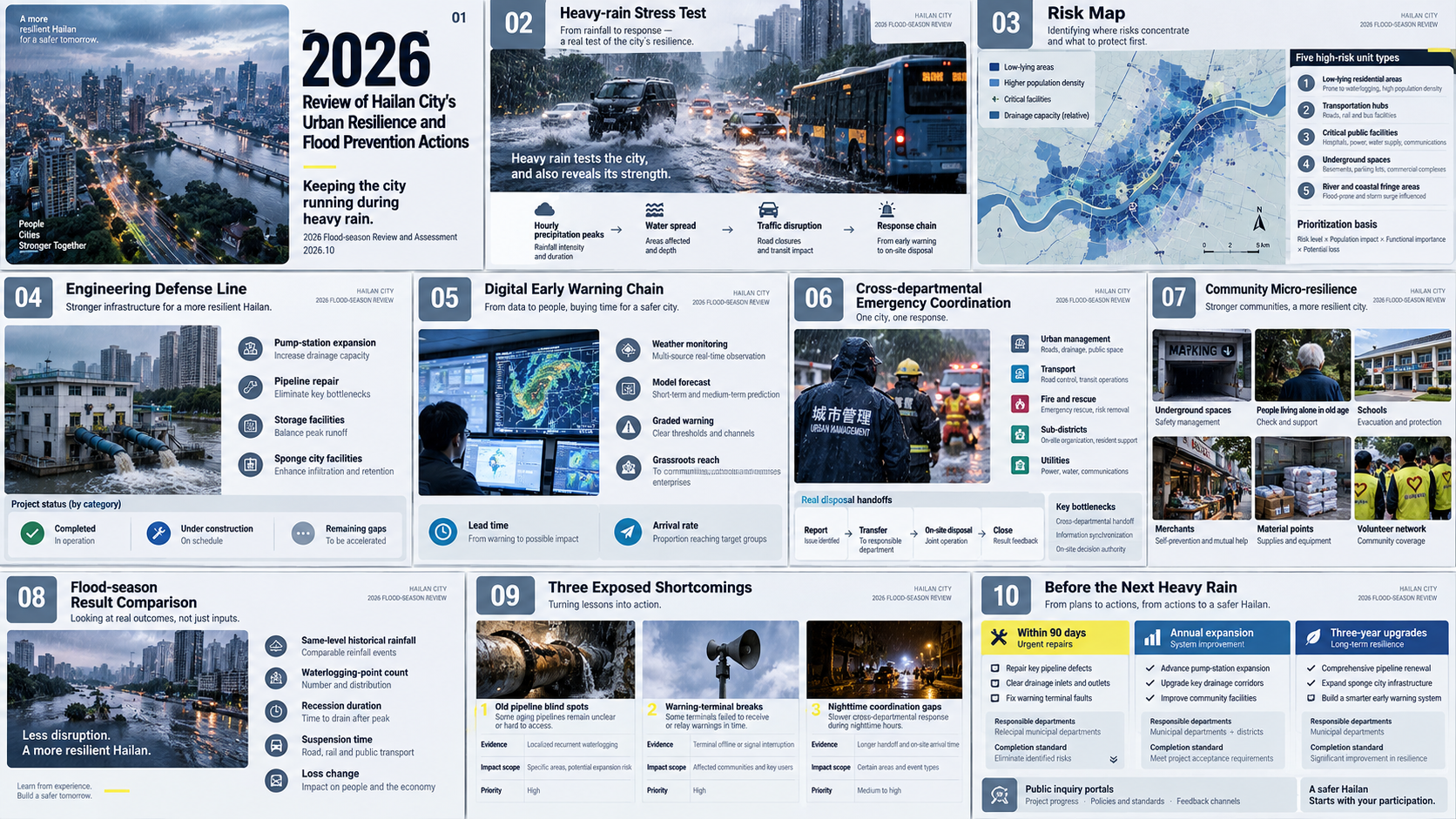
16:9、10 页报告型 PPT 设计,使用大尺度雨后城市纪实摄影、国际主义网格、暴雨蓝紫与荧光黄警示色,复盘海岚市 2026 汛期城市韧性防涝行动。
提示词 / Prompt
中文提示词
设计一套 10 页、16:9 的报告型 PPT,标题为《海岚市城市韧性防涝行动复盘》,用于 2026 汛期评估。以大尺度纪实摄影和清晰信息架构建立视觉系统:用模块网格与基线网格锁定列宽、边距、标题节奏和正文节奏;用格式塔接近律与共同区域将内容组织为可扫读板块;用编辑节奏交替安排主视觉页、留白信息页和分栏数据页。使用非对称数学网格统领对齐,以纪实摄影的激进裁切和影像尺度制造叙事停顿,以克制的几何无衬线字体和统一组件保持一致,并用相邻色域关系校准章节色签和信息卡,但不要机械临摹任何被提及的历史设计方法。建立可替换的色彩角色:主视觉场占 55%–70%,使用中暗值、中高饱和度并保留自然明暗层次;纸面背景占 20%–35%,使用高明度低饱和冷灰白;结构文字占 8%–15%,使用近黑色并保持强投影反差;章节编码与关键提示占 3%–8%,使用等权高纯度色,在相邻模块间形成明显冷暖和饱和度跳变。主题或品牌色变化时,只替换一次,并按主视觉、背景、文字、编码和提示逐项映射,同时保持面积比例、明度序列、色度差、邻接关系和对比强度。页面采用非对称多栏网格。封面左侧用贯穿上下的大圆角雨后城区高位俯视纪实影像,右侧堆叠超大时间信息和短标题;主题页以小型标识、主题标题和超大时间形成三段阅读。内容页组合分栏文本、等高卡片、贴边窄幅章节色签,允许标题或摄影局部跨列,以单一指向折角收束信息卡,并按标题或焦点影像、摘要、细节的顺序阅读。摄影使用真实环境光、细微颗粒和由近及远的明度压缩,先做自然影调校正,再以圆角遮罩裁切,保留边缘细节和局部高光。信息页使用无纹理哑光底,叠加低透明度轮廓数字、单线几何图标和细色条,按背景、影像或卡片、结构线、文字、编码的顺序合成。搭配同骨架几何无衬线字体:超大、粗窄的展示字可跨列或转为空心描边并压叠在摄影上;正文使用常规字重和较大行距;说明文字更小且字距更宽;中英文按光学黑度对齐,并校正数字、全角标点和圆角边界的光学边距,正文避开繁复影像。以暴雨蓝紫为主视觉、冷灰白为背景、荧光黄为提示色、近黑为结构文字。内页采用斜向事件轨迹、窄宽不等双栏、局部跨列风险地图和满页结论轮换;标题右对齐并以编号先行,时间复盘紧凑,风险解释留白,行动清单再次提高密度。包含以下 10 页:01 封面——让城市在暴雨中保持运行,锁定 2026 汛期复盘主题与评估日期;02 暴雨压力测试——按小时呈现降雨峰值、积水扩散、交通受阻和响应链;03 风险地图——叠加低洼片区、人口密度、关键设施和排水能力,识别五类高风险单元及优先级依据;04 工程防线——呈现泵站扩容、管网修复、调蓄空间和海绵设施,区分已完成、在建和待补缺口;05 数字预警链——说明气象监测、模型预报、分级预警和基层触达,使用提前量和到达率验证效能;06 跨部门应急协同——通过真实处置流程展示城管、交通、消防、街道和公共事业单位的任务交接、耗时和堵点;07 社区微韧性——聚焦地下空间、独居老人、学校和商户,说明社区预案、物资点和志愿网络覆盖;08 汛期结果对照——将本年度与历史同等级降雨对比,呈现积水点数量、退水时长、停运时间和损失变化,不只报告投入;09 暴露出的三处短板——明确老旧管网盲区、预警末端断点和夜间协同不足,分别给出证据、影响范围和整改优先级;10 下一场暴雨前——形成 90 天修补、年度扩容和三年系统升级路线,落实责任部门、完成标准和公众查询入口。整体呈现可信、清朗、务实、开放、有机且行动导向,不编造统计数据、徽标或无依据的信息。
English prompt
Design a 10-page, 16:9 report-style presentation titled ‘Review of Hailan City’s Urban Resilience and Flood Prevention Actions’ for the 2026 flood-season assessment. Build the visual system around large-scale documentary photography and clear information architecture: modular and baseline grids lock columns, margins, title rhythm, and body rhythm; Gestalt proximity and common-region grouping create scannable blocks; editorial pacing alternates main-visual pages, whitespace information pages, and multi-column data pages. Use an asymmetric mathematical grid for alignment, radical documentary cropping and image scale for narrative pauses, a restrained geometric sans-serif system and unified components for consistency, and adjacent-color relationships to calibrate chapter tabs and information cards without mechanically imitating any named historical design method. Establish replaceable color roles: main visual field 55–70% in medium-dark, medium-high-saturation values while retaining natural tonal range; paper background 20–35% in bright low-saturation cold gray-white; structural text 8–15% in near-black with strong projection contrast; chapter coding and key prompts 3–8% in equally weighted high-purity colors with visible temperature and saturation jumps. If themes or brand colors change, map them once across visual, background, text, coding, and prompt roles while preserving area ratios, brightness sequence, chroma difference, adjacency, and contrast intensity. Use asymmetric multi-column pages. The cover uses a large rounded-corner high-angle aerial view of the city after rain running through the left side, with oversized time information and short title stacked on the right. Theme pages combine small logos, theme titles, and oversized time into three reading stages. Content pages combine column text, equal-height cards, narrow edge-aligned chapter tabs, occasional cross-column titles or photographs, single-point folded card corners, and a reading order of title/focal image, summary, then details. Photography uses real ambient light, subtle grain, near-to-far brightness compression, natural tone correction before rounded-mask cropping, retained edge detail and local highlights. Information pages use matte textureless backgrounds, low-opacity outline numbers, single-line geometric icons, and thin color bars synthesized as background, image/card, structural lines, text, then coding. Pair geometric sans-serifs: oversized bold condensed display type can cross columns or become hollow outlines over photography; regular, more widely spaced body text; smaller, more widely tracked captions; align Chinese and English by optical blackness and correct optical margins around numbers, full-width punctuation, and rounded boundaries. Keep body copy away from busy images. Use storm blue-purple as the main visual, cold gray-white background, fluorescent yellow prompts, and near-black structural text. Inner pages use diagonal event trajectories, unequal narrow/wide double columns, partial cross-column risk maps, rotating full-page conclusions, right-aligned numbered titles, compact time review, generous risk-explanation whitespace, and denser action lists. Include these ten pages: 01 Cover—Keeping the city running during heavy rain, 2026 flood-season review and assessment date; 02 Heavy-rain stress test—hourly precipitation peaks, water spread, traffic disruption, and response chain; 03 Risk Map—low-lying areas, population density, critical facilities, drainage capacity, five high-risk unit types and prioritization basis; 04 Engineering Defense Line—pump-station expansion, pipeline repair, storage, sponge facilities, completed/under construction/gaps; 05 Digital Early Warning Chain—weather monitoring, model forecast, graded warning, grassroots reach, lead time and arrival rate; 06 Cross-departmental Emergency Coordination—real disposal handoffs, time, and bottlenecks among urban management, transport, fire, sub-districts, and utilities; 07 Community Micro-resilience—underground spaces, people living alone in old age, schools, merchants, plans, material points, and volunteer-network coverage; 08 Flood-season Result Comparison—same-level historical rainfall, waterlogging-point count, recession duration, suspension time, and loss change, not inputs alone; 09 Three Exposed Shortcomings—old pipeline blind spots, warning-terminal breaks, nighttime coordination gaps, each with evidence, impact scope, and priority; 10 Before the Next Heavy Rain—90-day repairs, annual expansion, three-year upgrades, responsible departments, completion standards, and public inquiry portals. Make the overall presentation credible, clear, pragmatic, open, organic, and action-oriented, with no invented statistics, logos, or unsupported data.
探索更多图片和视频提示词 · 生成图片 · 生成视频 · 在 AI 画布中创作
相关作品
- 玻璃番茄温室 · 自然科学
Moss Image 原创创意图集|自然科学|玻璃番茄温室。原创提示词生成。
- 复古手绘城市旅行徽章插画模板
将来源中的方括号占位符改为明确的双语变量,并提供可直接使用的京都默认值与准确中文对应项;保留暖白底、圆形旅行徽章、黑墨线稿/交叉排线、少量目的地代表色、上方标题和下方短标语。
- 竹林弓手 · 黑白银盐
Moss Image 原创创意图集|黑白银盐|竹林弓手。原创提示词生成。
- 冰川独木舟 · 建筑杂志
Moss Image 原创创意图集|建筑杂志|冰川独木舟。原创提示词生成。
- 法式复古水彩旅行日记封面模板
把地点与地标占位整理为有准确双语默认值的变量模板;修正来源末尾的英文拼写错误,保留法式复古旅行插画、水彩与水墨手绘质感、封面排版和指定历史文案。
- 温馨居家室内照片与水彩双联艺术版式
整理为竖幅4:5的室内主题编辑版式:上方为温馨客厅照片,下方为同一空间的复古纸本水彩转绘,保留奶油沙发、彩色靠垫、木茶几、复古地毯、绿植、书架、植物画、窗光与暖吊灯;附精确英文手写短句。原始房间图仅作为待阶段3核实的构图参考依赖,不声称已传入。