OpenZhenZhen AI 提示词画廊 · gpt-image-2.5 · image
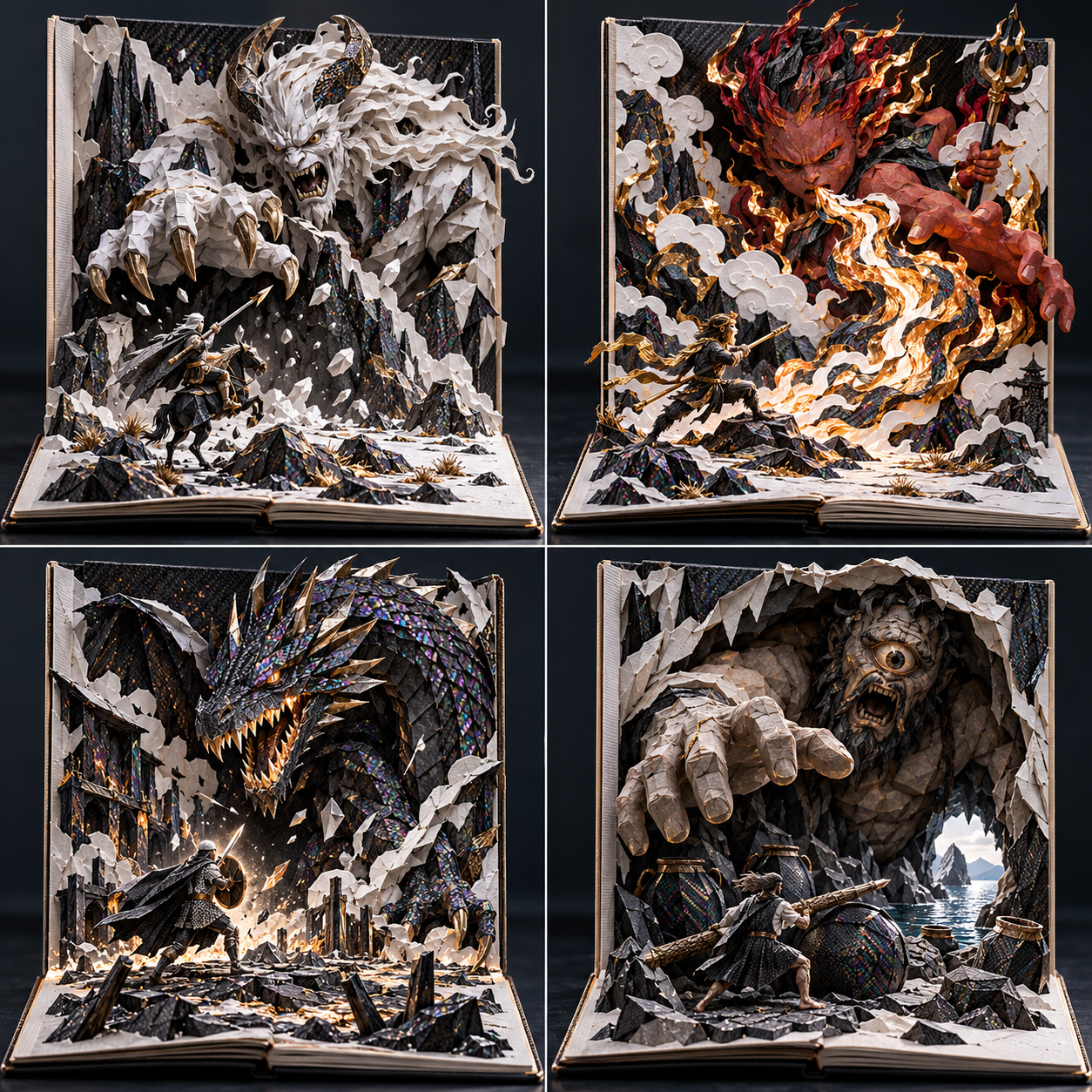
立体书舞台的四格宏观叙事模型
Four-Panel Macro Narrative Model of a Pop-Up Book Stage
以2×2网格呈现四本公版文学作品的微缩立体书场景:每本书以90度L形展开,英雄与巨型对手形成极端尺度对比,对手冲破垂直书页;叙事与碳纤维/折纸混合材质输入分离,色板只由材质输入决定。
提示词 / Prompt
中文提示词
创作一张正方形宏观摄影风格的编辑类主视觉,以2×2网格呈现四个彼此不同的概念立体书微缩场景,输出目标为4K(不保证实际分辨率)。四个公版文学故事片段依次为:Shahnameh《列王纪》:Rostam 鲁斯塔姆对战 White Demon 白魔;Journey to the West《西游记》:Sun Wukong 孙悟空对战 Red Boy 红孩儿;Beowulf《贝奥武夫》:Beowulf 贝奥武夫对战 the dragon 恶龙;The Odyssey《奥德赛》:Odysseus 奥德修斯遭遇 Polyphemus 独眼巨人波吕斐摩斯。仅使用经确认属于公版的原作故事意象,不复现仍受版权保护的现代译文或改编。。四格统一采用以下材质方向:Carbon fiber and origami hybrid 碳纤维与折纸混合风格;matte black 哑光黑、iridescent woven texture 虹彩编织纹理、crisp white 纯白、metallic accents 金属点缀。。每一格都是一本恰好呈90度展开的书:垂直后封面构成后方墙面,水平书页构成地面。书籍即舞台,材质即意义。每个微缩场景中,微小且可辨认的主角面对巨大的对手;对手冲破书籍后封面的垂直Z轴。保持每本书的轮廓与L形结构不变。 每格的主角、对手和环境只能根据对应故事片段推演。按阅读顺序(左上、右上、左下、右下)维持四个故事与画格的一一对应,并使四个场景明显不同。不要擅自加入受版权保护的现代角色或改编。色板严格只由材质输入决定,不能由故事决定:统一运用其碳纤维/折纸材质逻辑,并按输入呈现哑光黑、虹彩编织纹理、纯白及金属点缀。 呈现触感鲜明、超写实且具收藏感的概念艺术,形成极端微距尺度对比,准确表现材料物理、书页与封面的细节;碎片的破裂方式须符合所选材质。整体传达敬畏感与叙事合成感,并让四个独立画格清晰易读。不要增加画格、无关道具、文字、标志或水印。
English prompt
Create one square macro-photography editorial key visual as a 2×2 grid of four distinct conceptual pop-up-book dioramas, targeting 4K output without treating resolution as guaranteed. Use these four public-domain literary story episodes: Shahnameh《列王纪》:Rostam 鲁斯塔姆对战 White Demon 白魔;Journey to the West《西游记》:Sun Wukong 孙悟空对战 Red Boy 红孩儿;Beowulf《贝奥武夫》:Beowulf 贝奥武夫对战 the dragon 恶龙;The Odyssey《奥德赛》:Odysseus 奥德修斯遭遇 Polyphemus 独眼巨人波吕斐摩斯。仅使用经确认属于公版的原作故事意象,不复现仍受版权保护的现代译文或改编。. Use this shared material direction for all four panels: Carbon fiber and origami hybrid 碳纤维与折纸混合风格;matte black 哑光黑、iridescent woven texture 虹彩编织纹理、crisp white 纯白、metallic accents 金属点缀。. Each panel is its own open book at exactly 90 degrees: a vertical back cover forms the rear wall and a horizontal page forms the floor. The book is the stage and the material is the meaning. In each miniature scene, a tiny recognizable protagonist faces a gigantic antagonist; the antagonist breaches the vertical Z-axis of the back cover. Keep each book's silhouette and L-shaped topology intact. Infer each panel's protagonist, antagonist, and environment only from its corresponding narrative episode. Keep the same four narrative-to-panel assignments in reading order (top-left, top-right, bottom-left, bottom-right), and make the four scenes clearly distinct. Do not invent copyrighted modern characters or adaptations. Derive the palette strictly from the aesthetic input, never from the narrative: apply its carbon-fiber/origami material logic consistently, with matte black, iridescent woven texture, crisp white, and metallic accents as specified. Render as tactile hyperreal collectible concept art with extreme macro scale contrast, precise material physics, fine book-page and cover construction, and debris whose breakage follows the chosen materials. Communicate awe and narrative synthesis, and keep all four editorial panels legible. No extra panels, unrelated props, lettering, logos, or watermarks.
探索更多图片和视频提示词 · 生成图片 · 生成视频 · 在 AI 画布中创作
相关作品
- 成年东亚女性陶艺家 · 移轴摄影
Moss Image 原创创意图集|移轴摄影|成年东亚女性陶艺家。原创提示词生成。
- 成年非洲裔男性花艺师 · 镜面叙事
Moss Image 原创创意图集|镜面叙事|成年非洲裔男性花艺师。原创提示词生成。
- 果冻海岛 · 彩色玻璃
Moss Image 原创创意图集|彩色玻璃|果冻海岛。原创提示词生成。
- 镜面盐湖 · 陶瓷釉彩
Moss Image 原创创意图集|陶瓷釉彩|镜面盐湖。原创提示词生成。
- 伊布 · 棱镜折射
Moss Image 原创创意图集|棱镜折射|伊布。原创提示词生成。
- 成年南亚男性咖啡烘焙师 · 棱镜折射
Moss Image 原创创意图集|棱镜折射|成年南亚男性咖啡烘焙师。原创提示词生成。